Introduction: The Unstoppable Legacy
Since its debut in 1979 as a military-purpose off-roader, the Mercedes-Benz G-Class (or G-Wagen as purists call it) has defied every automotive trend. While most vehicles soften and modernize with each redesign, the G-Class has managed to evolve without losing the boxy, utilitarian silhouette that made it an icon. For enthusiasts, collectors, and aftermarket builders, understanding the differences between the three modern generations is essential when choosing parts, planning modifications, and making buying decisions.
This guide breaks down every major difference between the W463 (1990–2018), W464 (2019–2024), and W465 (2025–present) G-Class generations. Whether you are restoring a classic W463, upgrading a W464, or curious about what the latest W465 brings, you will find everything you need to know here.
Section 1: W463 (1990–2018) — The Classic
The W463 generation represents the G-Class that the world fell in love with. Initially launched in 1990, the W463 took the utilitarian W460 platform and added a layer of luxury that no one expected from a military-grade off-roader. For nearly three decades, Mercedes kept the W463 alive with continuous engine updates, interior refreshes, and special editions — all while preserving the fundamental design that made the G-Wagen instantly recognizable.
Key Features of the W463
The W463 is defined by its analog character. The driving experience is raw by modern standards: heavy steering, a bouncy ride on solid axles front and rear, and an interior that, while luxurious for its time, now feels delightfully old-school. Under the hood, the W463 saw a wide range of engines, from the G500’s V8 to the fire-breathing G63 AMG’s twin-turbo V8, and even the monstrous G65 AMG V12.
The interior featured physical gauges, a small infotainment screen in later models, and Mercedes build quality from an era when switchgear felt like it could survive a nuclear blast. The front seats were comfortable but lacked the ventilation and massaging functions found in modern luxury SUVs. Rear seat space was acceptable but not generous.
The W463’s Iconic Design
The W463’s design language is pure, unfiltered G-Class: exposed door hinges, a flat windshield, prominent turn signals mounted on the front fenders, a rear-mounted spare tire, and a step bar integrated into the rear bumper. The fuel filler cap is exposed on the left rear quarter panel, and the tailgate hinges on the right — a configuration unique to the G-Class.
Modification Potential
The W463 is a dream platform for builders. The aftermarket ecosystem is enormous: widebody kits from Brabus and Mansory, suspension upgrades from Bilstein and Eibach, custom bumpers from aftermarket specialists, and interior conversion packages. Because the W463’s basic architecture remained unchanged for 28 years, parts compatibility across model years is exceptional. If you are looking for W463 interior upgrade parts, you will find everything from complete dashboard swaps to custom carbon-fiber trim kits and retro-modern infotainment replacements.
Section 2: W464 (2019–2024) — The Modern Icon
When Mercedes announced the W464 in 2018, traditionalists held their breath. A ground-up redesign of the G-Class could have gone horribly wrong. Instead, Mercedes delivered a masterclass in evolution. The W464 kept the G-Class’s soul while comprehensively updating every system, panel, and component.
A Ground-Up Redesign
The W464 rides on a completely new chassis. The front solid axle was replaced with an independent front suspension, dramatically improving on-road handling without sacrificing off-road capability. The steering became electrically assisted, lighter, and more precise. The body is wider, the track is broader, and the aerodynamics — while still boxy — were measurably improved.
Structurally, the W464 body is far more rigid, using a higher percentage of high-strength steel and aluminum panels. The doors still close with that trademark G-Wagen thunk, but they now do so with less effort thanks to redesigned hinges and latch mechanisms.
Interior Revolution
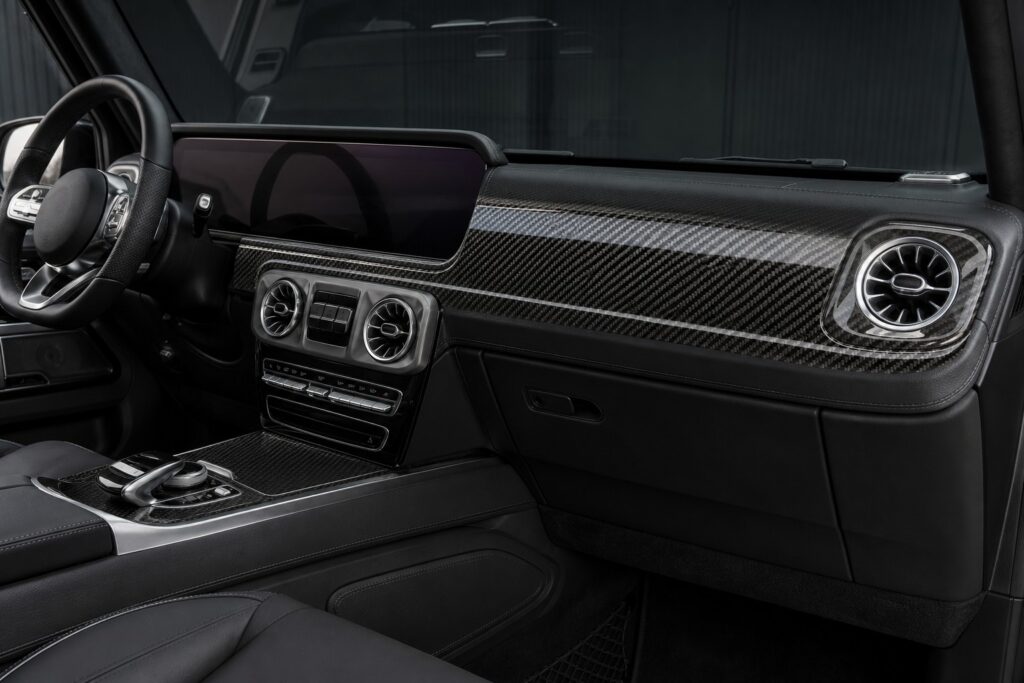
The W464 interior was a quantum leap. Gone were the analog gauges and small screens. In their place: a dual 12.3-inch widescreen cockpit that combined the instrument cluster and infotainment display under a single pane of glass. The dashboard adopted the aviation-inspired design language seen in the E-Class and S-Class, complete with turbine-style air vents, an analog clock between the center vents, and COMAND controller on the center console.
Material quality reached new heights. Genuine leather, open-pore wood, brushed aluminum, and diamond-pattern stitching became the norm. The seats were redesigned with ventilation, massage, and multi-adjustable bolsters. Rear seat space grew by inches, making the W464 genuinely comfortable for five adults.
Technology Upgrades
The W464 introduced modern driver-assistance systems: adaptive cruise control, lane-keeping assist, blind-spot monitoring, 360-degree camera, and active parking assist. The COMAND infotainment system added Apple CarPlay and Android Auto, navigation with augmented reality, and a Burmester 3D surround sound system that turned the cabin into a concert hall.
Under the hood, the W464’s G63 AMG switched to the M177 4.0-liter twin-turbo V8 producing 577 horsepower, while the G500 (later G550) used the M176 4.0-liter twin-turbo V8 with 416 horsepower. Both engine options were paired with the silky-smooth 9G-TRONIC nine-speed automatic transmission.
The W464 in the Aftermarket
The W464 quickly became the platform of choice for high-end builders. The wider body and independent front suspension opened new possibilities for wheel and tire packages. Fitment options that were impossible on the W463 became standard on the W464. Builders began pushing 24-inch wheels with custom offsets, lowering links for air suspension systems, and LED daytime-running light conversions.
If you are shopping for W464 aftermarket parts, you will find excellent options for front bumper replacements, carbon-fiber widebody kits, performance exhaust systems, illuminated grille upgrades, and custom steering wheel conversions.
Section 3: W465 (2025+) — The Latest Evolution
The W465 arrived for the 2025 model year as a mid-cycle refresh of the W464 platform — but calling it a simple “facelift” undersells the scope of changes. Mercedes implemented significant mechanical, electrical, and cosmetic updates that make the W465 a genuinely distinct generation.
What Changed in the W465
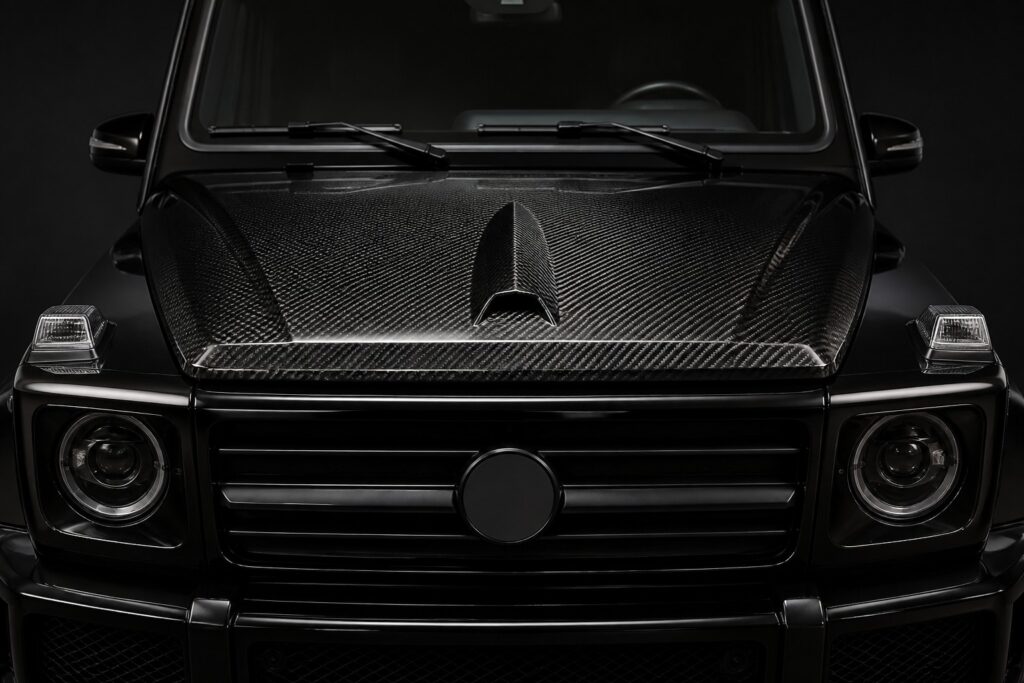
On the outside, the W465 received redesigned front and rear bumpers, a new grille pattern, and a restyled hood with raised power domes on AMG models. The headlights adopted the latest Mercedes LED Multi-Beam technology with a new signature graphic that uses three individual LED blocks rather than the W464’s round projector modules. The rear lights gained a new three-dimensional LED graphic.
The AMG Line package became standard on most markets, bringing a sportier front apron with larger air intakes, side sill extensions, and a revised rear diffuser. The G63 retained its signature quad-exhaust setup but with new tailpipe finishers.
Powertrain Updates
The biggest mechanical news for the W465 is the introduction of mild-hybrid technology on the G550 (now G500 in some markets) and a 48-volt electrical system. The G550’s 4.0-liter V8 gains an integrated starter-generator (ISG) that adds 20 horsepower and 148 lb-ft of torque during acceleration, smoothing the start-stop cycle and improving fuel economy.
The G63 AMG received a power bump to 585 horsepower from the same 4.0-liter twin-turbo V8, paired with an updated nine-speed automatic that delivers quicker gear changes. The available AMG Performance exhaust system now features adjustable flaps for a wider range of sound profiles.
The Electric G580
Perhaps the most significant addition to the W465 lineup is the fully electric G580 with EQ Technology. This is not merely a conversion — it is a ground-up electric G-Class that retains the G580 badge and the ladder-frame chassis. Four individual electric motors (one at each wheel) provide torque vectoring capabilities that surpass any combustion G-Class. The “G-Turn” function allows the vehicle to spin on its axis, while “G-Steering” tightens the turning radius by braking the inside rear wheel.
The G580 carries a 116 kWh battery and delivers an estimated range of around 250 miles. Visually, the electric G-Class is distinguished by a closed-off grille panel, aero-optimized wheels, and a rectangular spare tire carrier that houses the charging cable.
Interior Refinements
Inside the W465, the most noticeable change is the switch to Mercedes’ latest MBUX infotainment system with the “Hey Mercedes” voice assistant, an Offroad Cockpit display mode, and wireless Apple CarPlay/Android Auto. The steering wheel was updated to the latest Mercedes design with capacitive touch controls. The center console received revised switchgear for the differential locks, which now feature a more intuitive toggle design.
Seat upholstery options expanded, and the ambient lighting system now offers 64 colors with customizable zones. The Burmester 4D surround sound system — available as an option — integrates seat transducers that pulse with the music for a truly immersive experience.
For those looking at W465 conversion options, the aftermarket has already begun developing lighting upgrades, bumper conversions, and interior trim packages that build on the W465’s refreshed design.
Section 4: Exterior Comparison Side-by-Side
| Feature | W463 (1990-2018) | W464 (2019-2024) | W465 (2025+) |
|---|---|---|---|
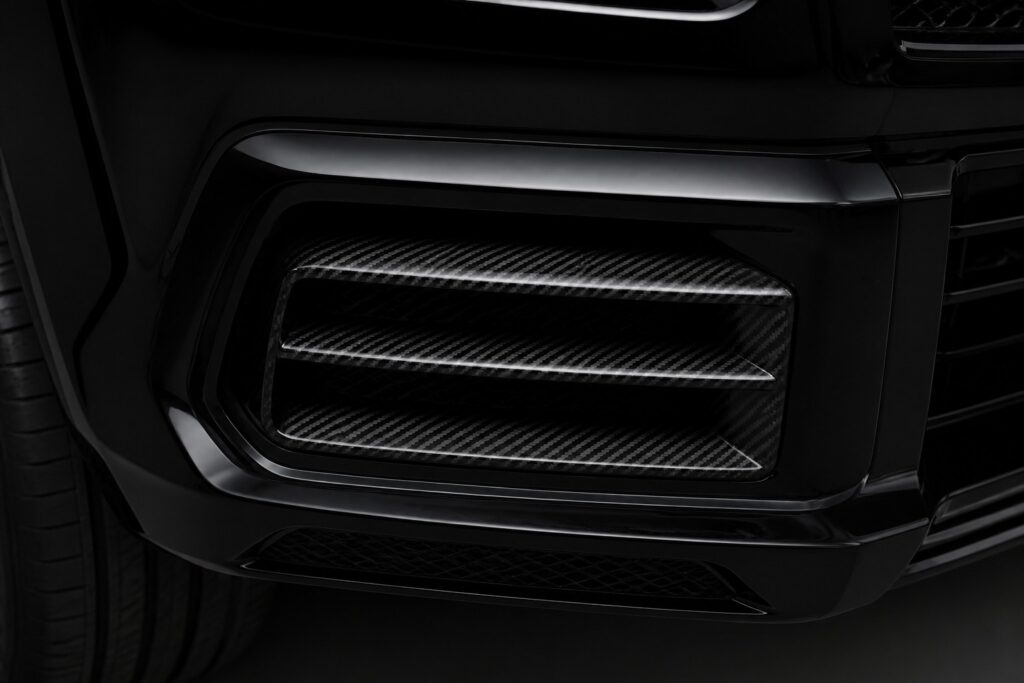
| Front Bumper | Narrow, exposed tow hooks, square fog lights | Wider, integrated fog lights, optional AMG styling | Restyled, larger air intakes, new lower grille |
| Grille | Three horizontal chrome slats, small Mercedes star | Larger grille, single or double slats, large star | Updated mesh pattern, active shutters on G550 |
| Headlights | Round halogen or bi-xenon projectors | Full LED with round projectors, LED DRL ring | Multi-Beam LED, three-block signature graphic |
| Hood | Flat hood with raised center section | Power domes on AMG models | More pronounced power domes, new contour lines |
| Fenders | Narrow fenders, exposed turn signal housings | Wider fenders, integrated side markers | Same width as W464, sharper crease lines |
| Rear Bumper | Step-integrated bumper, exposed spare tire mount | Clean bumper design, parking sensors integrated | New diffuser design, revised exhaust outlets |
| Spare Tire | Exposed full-size spare on swing-away mount | Full-size spare with covered carrier | Covered carrier (G580 gets rectangular cover) |
| Wheel Options | 16″ to 20″ wheels | 18″ to 22″ wheels | 20″ to 24″ wheels, aero wheels for G580 |
Section 5: Interior Comparison
| Feature | W463 (1990-2018) | W464 (2019-2024) | W465 (2025+) |
|---|---|---|---|
| Dashboard | Horizontal layout, analog gauges, small screen (late models) | Dual 12.3″ widescreen, aviation-inspired vents | Same layout, MBUX 2.0, updated graphics |
| Infotainment | COMAND (late models), no touchscreen | COMAND with touchpad controller, Apple CarPlay | MBUX with voice assistant, wireless CarPlay/Android Auto |
| Steering Wheel | Four-spoke (early), three-spoke (late), physical buttons | Three-spoke sport wheel, touch buttons | New capacitive touch controls, flattened bottom |
| Seats | Manual or power, limited adjustment | Multi-contour with massage/ventilation | Revised stitching options, new leather grades |
| Center Console | Simple layout, mechanical diff lock switches | Elegant layout, brushed aluminum trim, COMAND knob | Updated diff lock toggle switches, new phone tray |
| Instrument Cluster | Analog speedometer and tachometer | Configurable 12.3″ digital display | Updated digital display with Offroad Cockpit mode |
| Ambient Lighting | Not available (early), basic (late) | 64-color ambient lighting | 64-color with multi-zone customization |
Section 6: Modification Compatibility
One of the most common questions among G-Class enthusiasts is which parts interchange between the three generations. Here is a practical breakdown.
W463 to W464 Compatibility
The W463 and W464 share almost nothing in terms of body panels or suspension components. The W464’s independent front suspension is completely different from the W463’s solid front axle, so wheel and tire fitment specs changed significantly. Bumpers, grilles, headlights, and fenders from the W463 will not fit the W464.
However, some interior accessories and certain engine components (particularly the M176/M177 engine family used in later W463 models and the W464) share part numbers. Wheel adapters exist for cross-generational wheel fitment, but the offset requirements differ.
W464 to W465 Compatibility
This is where aftermarket potential gets interesting. Since the W465 is a mid-cycle refresh of the W464, the chassis, doors, fenders, hood (with slight differences), and glass are shared. The following components are physically interchangeable with modifications or directly bolt on:
- Interior trim pieces: Center console, dashboard trim, and door panels share mounting points
- Wheels and tires: Identical bolt patterns and offsets
- Suspension components: Same springs, dampers, and control arms
- Exhaust systems: G63 cat-back exhausts from the W464 fit the W465
What changed that does NOT interchange:
- Front bumper: New mounting points for the W465’s restyled bumper
- Rear bumper: New diffuser design changes the mounting bracket positions
- Headlights: Different electrical connectors and modules
- Grille: Different latch mechanism and active shutter interface
For builders wanting the latest look, a W464 to W465 conversion kit typically includes the front bumper, grille, and associated trim along with the necessary brackets to adapt to the W464 chassis.
Cross-Generation Accessories
Certain accessories work across all three generations:
- Roof racks and cargo carriers: The roof gutter design has remained constant
- Floor mats and cargo liners: W464 and W465 mats are identical; W463 requires specific fitment
- Wheel spacers: W464 and W465 share bolt pattern (5×130) but W463 uses a different offset profile
- Performance tuners: Late W463 and W464 engines respond well to ECU tuning; W465 tuning is still emerging
Section 7: Which Generation Should You Buy For Modifications?
Choose the W463 If…
You want the original analog G-Class experience with the largest possible aftermarket ecosystem. The W463 is the platform of choice for extreme builds: widebody kits, engine swaps, custom interiors, and off-road overland conversions. The solid front axle gives you maximum articulation for serious rock crawling, and the simpler electronics mean fewer challenges when integrating custom systems. Prices are also lower on the used market, leaving room in the budget for modifications. Just be prepared for the maintenance demands of a vehicle that is, by modern standards, mechanically primitive.
Choose the W464 If…
You want the best balance of modern luxury and aftermarket flexibility. The W464’s wider body accepts larger wheels and tires without modification, the independent front suspension makes it a better daily driver, and the technology package keeps it competitive with current luxury SUVs. The aftermarket for W464 parts is mature and growing. This is the sweet spot for most builders: modern enough to be comfortable, classic enough to still feel like a G-Wagen.
Choose the W465 If…
You want the latest technology and the option to go electric. The W465 is the most refined G-Class ever produced, with the best on-road manners, the quietest cabin, and the most advanced safety systems. If you are building a show car or luxury daily driver and want the newest styling, the W465 is the obvious choice. However, the aftermarket is still catching up, so expect fewer modification options and higher parts prices in the first few years of ownership.
Conclusion
The Mercedes G-Class has evolved from a rugged military machine into one of the most distinctive luxury vehicles on the planet, and each generation offers something unique to the enthusiast and builder community. The W463 delivers classic analog character and the deepest aftermarket support. The W464 strikes the perfect balance between modern refinement and build-friendly architecture. The W465 represents the cutting edge, with electric powertrain options and the most polished driving experience yet.
No matter which generation you own or are considering, the G-Class remains one of the most rewarding platforms for customization and personalization. The box never changes — but how you build it is entirely up to you.
Explore Generation-Specific Parts
- W463 interior upgrade parts — Restore or modernize your classic W463 cabin
- W464 aftermarket parts — Bumpers, wheels, suspension, and more for the 2019-2024 G-Class
- W465 conversion options — Upgrade your W464 to W465 front-end styling
- W464 to W465 conversion kit — Complete bumper, grille, and trim package
- G-Class modification guide — Comprehensive resources for all generations
Last updated: May 2026. Specifications and compatibility information are based on publicly available data and may vary by market and model year. Always verify fitment with your parts supplier before purchasing.